Showing posts with label money. Show all posts

Sunday, November 03, 2013

Allowances

It's fun to drive a bunch of scouts to an outing. Besides a sing-a-long of What does the fox say, you get to learn a bit about the boys. Yesterday the topic of allowances came up. This is since recent an important topic for my son as he is responsible to pay a portion of the monthly cellphone plan. He saved and paid half of a new iPhone 5c. I added him to my plan with unlimited voice, text and internet. However he has to pay 50% of the $30 monthly service plan for his phone.

Both kids have been receiving a weekly allowance since last year. Saving is important. At this age, I want to also teach them how to spend. I use the iAllowance iPad application. I love the fact that you can set up an automatic interest for the savings account, so they can appreciate the magic of compound interest. Also it is not all about the money: you can earn stars and free ice cream.

Until recent, both kids were able to earn $3 every week. It was not tied to any chores. Now that obviously my son is coming up short to pay his monthly cellphone plan, he asked to revise the allowance amount. We are changing the allowance upwards, though with strings attached.

Here are those nasty terms and conditions:

  1. You do not earn any allowance if you do not participate in the regular household chores. If you do not do any of the basic chores such as making your bed, cleaning up your room, cleaning of the table, there is no allowance this week. 
  2. No allowance is given if you do not practice your music instruments or sports. 
  3. Your allowance includes a big portion for you to spend and learn how to spend wisely and another portion to save. 
  4. You can earn extra allowance by doing a special chore such as planting vegetables in the planter box or cleaning the car.  
  5. It is your responsibility to make sure your allowance is credited to your iAllowance account. 

Based upon an article in the Huffington post, the amount is raised to about $0.75 per year of age.
Sunday, October 02, 2011

California and bust


I keep roughly the same schedule on weekends as I keep during the week. I wake up early, I have a macchiato and read emails. However, in the weekend, I read blogs and personal emails I've saved up during the week. The Consumerist blog pointed me to an interesting article by Michael Lewis in Vanity Fair on California. Go read it - in its entirety. Here are a few interesting quotes to wet your appetite:
The average Californian, in 2011, had debts of $78,000 against an income of $43,000. 
The head parole psychiatrist for the California prison system was the state’s highest-paid public employee; in 2010 he’d made $838,706. 
San Jose has the highest per capita income of any city in the United States, after New York. It has the highest credit rating of any city in California with a population over 250,000. It is one of the few cities in America with a triple-A rating from Moody’s and Standard & Poor’s, but only because its bondholders have the power to compel the city to levy a tax on property owners to pay off the bonds. The city itself is not all that far from being bankrupt.
For instance, back in 2002, the San Jose police union cut a three-year deal that raised police officers’ pay by 18 percent over the contract. Soon afterward, the San Jose firefighters cut a better deal for themselves, including a pay raise of more than 23 percent. The police felt robbed and complained mightily until the city council crafted a deal that handed them 5 percent more premium pay in exchange for training to fight terrorists.
He didn’t view the city’s (Vallejo) main problem as financial: the financial problems were the symptom. The disease was the culture.
Dr. Peter Whybrow thinks the dysfunction in America’s society is a by-product of America’s success. ... The human brain evolved over hundreds of thousands of years in an environment defined by scarcity. It was not designed, at least originally, for an environment of extreme abundance. 

After reading the article, two things came to mind:
(1) It is wrong we spent more on prisons than on education. (And yes, they are related.) Let's start by  revisiting the three strike law, especially for minor, non-violent felonies. At the same time, nobody is worth an $800K salary.

(2) Where is the time when people lived within their means; people valued simple stuff. For my grandma, having survived two world wars in Europe, key was to have daily a good cup of coffee and a ham sandwich. It is a somewhat like in the old days on farm - live within your means.

I sometimes have the hear how in Europe this or that is better - "We drive smaller cars. We use less water. We produce less waste. We don't use as much plastics. etc. etc." All true. But it is only true because governments have made people care and adjust by levying higher taxes. As Peter Whybrow stated in the article, it is because we don't know what to do with abundance. So if you want the people to care, let's raise taxes (temporarily) to fix both at the same time: adjust the culture and have some funds to fix the educational system.

Sunday, February 13, 2011

When buying a car


We recently had to replace our old car. I had been secretly on the look out for a replacement car. However, with the deadline to re-register our old car coming up, and the need to fix a few things to pass the smog check, we decided to buy immediately.

The selection process
I made a check list with features we wanted in a car. My wife and I both check of whether it was important, nice to have or a don't car.

Looking around us every day, we had settled on three or four candidate models: VW Jetta Wagon TDI, Subaru Forester, Toyota Rav4 and the Honda CRV. All were good brands. It was time to check them out closer and we spent two Sundays on the Auto-row. We test drove the Subaru and the Honda CRV and with some internet resource, we paired it down to the Subaru Forester.

Now finding the model, color and price we wanted. This is always the part most dreaded when buying a car. And we wanted to trade-in our old car. Upon a great tip from a friend, we tried autobytel.com and got some initial internet pricing. Sending emails back and forth between dealerships within a 50 mile radius, the price kept on dropping, from about $26500 to $22400 for the same model and options. You might have to be flexible on the color. At the end I never had to have the one on one conversation with the car salesman in his office, going back and forth with 'his manager' on the price. We did have a great price in hand when we drove up to the dealer, about 50 miles from here.

The trade-in was simple. The trade-in was negotiated at the dealership. First of all, I made it clear that the deal was {trade-in,new car}, and not new car alone. I was willing to leave if I didn't get a good price on the old car. We had a price in mind and when their offer was about dead on, we felt we might be able to get something more. We negotiated about a few options on the new car and kept the trade-in price fixed. For example, a new back bumper protector is $80. However the cost for the dealer is much less, so it was easy for them to throw in such items.

Lastly, although it is said, that financing the car is beneficial to the dealership and you might be able to get a cheaper price (as some of it is recovered by the dealer in loan-recruitment-fees), it didn't appear to have a difference or our final price. Having cash on hand helps in my opinion.

Thus, negotiating over the internet and willing to drive a few miles has made buying a car fun and without too much hassle.

Friday, July 31, 2009

Summer project

Every year we tackle a major home project. This year we decided to remodel our bathrooms. Countless weekends later, faucet testing, tile sampling and granite scratching later, we're done.

When we purchased our house it had been a rental property. As a result, the inside of the house was serving a utilitarian purpose and wasn't kept up very nicely. Similarly, our bathrooms were basic bathrooms with plastic tub sides and a cheap vanity. It has done the job since we moved in, but it was time to redo them.

How did we start tackling the remodel?
First we shortcircuited the contractor finding process. We had a great recommendation through some friends: Royal Kitchen and Bath and got a decent quote. A little higher than competitive quotes, but I wanted somebody who was going to see the job through. Some companies were horrible unprofessional, already during the bidding process. You would think that in these though times they would behave like sheep hungry for a design win.

Where did we shop for material?
It is worthwhile to be intimately involved in the material selection and go shop around. Don't just take what the contractor offers. A good contractor will recommend you quality places to visit. We spent many weekends checking out faucets, granite, or vanities. Here's a short list of places in the South Bay we selected from:

Shower and bath material: American Custom Marble, San Jose, CA
Bath tub: rvcloud.com
Shower doors: Blossom Hill Showers
Toilets: Homeclick.com and Home Depot
Faucets: Lowe's
Vanities (Jensen Cabinets): Southern lumber, San Jose, CA
Tiles: Tileshop, Brokaw, San Jose, CA
Molding: The Molding Store, Brokaw, San Jose, CA

What material choices did we make?
  • Steel vs Cast iron vs Acrylic bath tub: the difference is price, comfort and quality. Steel are cheaper. Cast irons are heavy as hell to install and take time to warm up. Plus if they scratch you have a tough time to fix. Acrylic tubs sometimes require a concrete base to be installed to avoid flexing. We selected a solid acrylic tub: Kohler Archer 19" high which is taller than most tubs. But with great back support.
  • Faucet brands range from $30 to $900. We selected a brushed nickel finish and a decent price quality faucet from Delta. If you select the Lowe's or Home Depot model you get a good price. The shower set allows you adjust the temperature, as well as the water flow through two different handles.
  • Tile or wooden baseboards: The joint of tile baseboards with the floor tile might break as a wooden house flexes. We opted for a wooden/MDF baseboard.

What lessons have we learned?
A key lesson we learned is not to order big ceramic items via the internet. We purchased one toilet (Toto Drake) through Homeclick.com. The shipment was arranged through UPS. First of all, two days before the toilet was to arrive, an email update informs me that only part will arrive in time and that the toilet base is delayed 1 week. If I knew this at purchase time I would not have gone this route. Worse was that the toilet base shipment then arrived one week later but damaged and needed to be reshipped. It had broken in pieces due to poor packaging and rought UPS shipment. As a result, the toilet was delayed for 2-3 weeks.

And one more item. As a a geek and Google fan-boy, we managed the project entirely on the net: we planned it via Google Docs and maintained a Bill of Materials in Google Spreadsheets. It was great to do competitive price check and updates from my phone while being in the store. We took pictures and shared them via Picasaweb.

Now we take a break and get ready later this year for our next project.

Friday, March 13, 2009

In Stewart we Trust

Bush is out of office. Obama versus Palin is long over. I wondered what Jon Stewart would be zooming in on next in his Daily Show. The answer : money; crooked money; mad money and the role the "analysts", "financial experts" and financial news shows played in the hype. 

If there is anything I learned from the dotcom bust, it is how venture capitalists and investment banks shared the same bed. Similarly check how many were sharing a bed in the housing bust. 

Thus Stewart went on a mission to critique the financial news channels and found a great poster child in loud mouth Jim Cramer, who hosts the Mad Money show on CNBC. 

This rest of this blog post is very simple. The video speaks for itself.


Friday, December 12, 2008

Wallstreet

I recently read The Film Club by David Gilmour. In this memoir, he chronicles the story of allowing his son Jesse to drop out of school as long as he watches three movies weekly with this father. David Gilmour is a former film critic and television host. Rather than letting his son troll the streets, he starts a father-son film club. As they cover various styles and classics, they also discus a lot about life, Jesse's girlfriends, and his friends. From the book I picked up a list of classic movies I have yet to watch:
  • Duel by Stephen Spielberg
  • Fast Times at Ridgemont High with Sean Penn
  • Jungle Fever by Spike Lee with a young Samuel L. Jackson
  • Breakfast at Tiffanies
  • Mean street by Martin Scorsese
  • The shining by Stanley Kubrick
  • Notorious by Alfred Hitchcock
  • Dity Harry Magnum Force
  • Wallstreet with Charlie Sheen, Michael Douglas and Martin Sheen
Amidst all the financial mess, I decided to start at the bottom and got Wallstreet by Oliver Stone from Netflix. It couldn't have been more timely. The news broke last week that Bernard Madoff's hedge fund was a giant $50 Billlion ponzi scheme. 

After learning about bail-outs, derivatives and credit default swaps from NPR's Planet Money blog, or after reading Michael Lewis' article about the financial mess you conclude that not much has changed. Financial companies will keep inventing products which are hard or impossible to understand. In the process, the ignorant will end up holding the bag. Even those who are cognisant they are ignorant and don't want to play, will end up holding part of the bag.

Saturday, May 24, 2008

Gotcha capitalism

Last year, I read John Bogle's little book of common sense investing, and learned how the little investment fees in the end can cost your dearly.

Tonight I started reading Gotcha capitalism by Bob Sullivan. The book is about how companies add hidden fees everywhere. No surprise there. I fall into the category of people who reviews every bill thoroughly. I fight back and don't mind going through several layers of phone support to get my money back. Example:
A few years ago, I received a $400+ cellphone bill. Ouch. My regular monthly bill is $75 for our family. As it turned out, they had dropped the free in network calling from my plan, several months before but only now did I reach the minutes limit. I was now billed for calling all our friends using the same cellphone provider. But worse, every call with my wife was rung up twice: once for me and once for my wife. Early calls to AT&T wireless were met with "Nothing we can do". It then changed to "Let's split it in half". That's when I realized there was more to fight for. It was just the right catalyst to start a spreadsheet. I took every phone number from the bill and figured out whether he/she belonged to AT&T wireless. With details in hand, resistance was futile (I can boast now). At the end the monthly bill was lower than regular. But it took some stubbornness.
Knowing there is a chance to beat the system, I am typically looking forward to the fight. This book appears to be written for me. In the first chapter of the book the author brings up how the real cost of a printer is difficult to estimate. Well, I am part of the few who attempted it. When purchasing a printer, I consider both the acquisition cost, the cost of a ink cartridge and the amount of pages I print per month.

One thing is clear early in the book: as a consumer in America, you are often alone. The influence and power of Federal Trace Commission (FTC) has been clipped. Worse, companies have been allowed to create one-sided contracts just by mailing you a letter. As such many companies made you to silently agree to mandatory arbitration and avoid the court system.

Friday, August 17, 2007

Common Sense Index Funds

The message of The Little Book of Common Sense Investing, by John Bogle is simple: Buy index funds and you'll do better than most investors. Yet the book counts 214 pages. Each chapter almost reads like a FAQ (frequently asked question). When it comes to investing, at the end, it all comes down to a single number: how much is left over.
"It may not be as exciting, but owning the classic stock market fund is the ultimate strategy. It holds the mathematical certainty that marks it as the gold standard in investing, for try as they might, the alchemists of active management cannot turn that own lead, copper or iron into gold. Just avoid complexity, rely on simplicity, take costs out of the equation, and trust the arithmetic."
"Remember, O stranger, arithmetic is the first of the sciences and the mother of safety." (Louis D. Brandeis, 1914)
"The two greatest enemies of the equity investor are expenses and emotions"
The lessons in the book are clear:

rule 1: Own businesses; don't speculate on emotions
  • Total investment returns - the gains made by businesses - were remarkably steady: 8 - 13% each year and averaging 9.5%.
  • The speculative return has added just 0.1% to the annual investment return.
rule 2: Own all businesses (best risk reducing strategy)
Don't look for the needle. Buy the hay stack.
  • Only 3 out of 355 equity funds (since 1970), or 8/10 of 1%, have survived and mounted a record of sustained excellent.
  • During the 39 year period (1968 to 2006) the S&P500 index fell into the bottom quartile of large cap core funds, in only 2 years and has not done so since 1979. The index has outpaced the average fund in 26 of the 35 years, including 11 of the past years.
rule 3: gross market return - costs = net return for the investor. Costs matter: compounding costs will eat your lunch and dinner
The "all-in" cost of equity fund ownership can come to as much as 3-3.5%/year. This includes the expense ratio, sale charges and initial sale charge. Compounding over 50 years, the investor who puts up 100% of the capital and assumes 100% of the risk, earned only 31% of the market return.
For 1980 - 2005:
  • S&P returned 12.5%/yr; $10,000 will grow to $170,800 before inflation (3.3%/yr); after inflation: $76,200.
  • Average Fund returned 10%/yr; $10,000 will grow to $98,200 before inflation (3.3%/yr); after inflation: $40,600
  • The impact of compounding costs over 25 years is a difference of 53%!
rule 4: gross market - costs - market timing and selection penalties = net return earned by mutual fund investors
There is a investment time lag which costs investors dearly. When you calculate it out, the $10,000K investment will grow to:
  • S&P invested: $76,200 (after inflation)
  • Average Fund: $16,700 (after inflation)
  • The impact of costs, counter productive market timing and selection penalties over 25 years is enormous: 22%! of what could have been if invested in an index fund.
rule 5: taxes are costs too. High turn over = taxes
Continuing the calculation:
  • S&P invested: 12.3% return - 0.6% (tax cost) - 3.3% (inflation) = 8.4%; $10,000 grows to $65,000.
  • Average fund: 10.0% return - 1.8% (tax cost) - 3.3% (inflation) = 4.9%; $10,000 grows to $23,100
  • Again the impact is substantial when compounded over many years.
So, this brings us to a simple summary: Bogle recommendations
  1. Serious money account = 95%
    Funny money account = 5%
  2. Invest serious money account 100% in index funds
    1. <>
    2. 85% S&P index
    3. 5% small cap index
    4. 10% value index
    5. short term bond fund
    6. inflation linked bonds
  3. Invest funny money (experiment)
    1. some in stock
    2. some in mutual funds
    3. commodity funds
    4. Avoid other funancial constructs
  4. Asset allocation: bond % == your age or (age -10) %

Tuesday, May 01, 2007

Coffeehouse Investor

I recently finished reading a small book by Bill Shultheis called "The Coffeehouse Investor". It reads easy and is written in a conversation style. The moral of the book is (1) to ignore Wallstreet: they only make money when there is movement in the market and (2) use a simple index investing style: don't try to outsmart the market. Make sure you at least match the market. For a preview of the three key principles of investing: outlined in the book, check out its website: http://coffeehouseinvestor.com/
The name of the book is based upon a weekly gathering of friends in a coffeeshop.
There are only two things puzzling about the book: (a) How did the author get out the door to have a coffee on a rainy Seattle Saturday morning at 5:45am (!) and (b) How did he convince his friends to join him.

Sunday, February 18, 2007

Home is where the tank is parked

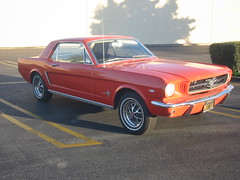
After we sold our old poppy orange 1965 Ford Mustang a few years ago, we were managing with just one car: a 1998 Honda Civic EX, which we purchased second hand. It has been a great and reliable car.
Pumpkin - my poppy orange 1965 Ford Mustang
We recently decided to buy a second car. It would make our commute easier and allow us to spend more time with the kids. One of us would drop them of at school, whereas the other could pick them up at an earlier time. So, the kids wouldn't have to spend so much time at school. We made the following list of criteria.

I love the unsexy station wagon as you get the space of an SUV without the bigger fuel bill. And a station wagon does drive more like a regular sedan. Some new SUV-station wagon cross-over models (i.e. Ford Edge, Chrysler Pacifica) looked promising, but none had the reliability or fuel efficiency we were looking for.

Decent fuel economy was important. We looked at the hybrids, but they are very pricey, even considering California State tax incentives and a donation from work to drive a hybrid.

Reliability was key. We used Consumer Reports as the deciding factor. Many American brands and models were quickly excluded. Also the Volkswagen Passat Wagon was no match because of its poor reliability.

Leather, satellite radio, a navigation system were not a high priority. We were ok with the basic luxury model.

A short list of models we liked included (in order of preference):
  1. Volvo V70
  2. Subaru Legacy Wagon
  3. Subaru Outback
  4. Subaru Forrester
  5. Honda Odyssey
  6. Toyota Sienna
  7. Volvo V50
We test drove most of them (except the minivans). All are very nice cars. All Subaru's are all wheel drive (AWD), which has poorer fuel economy. Furthermore, stability control, a feature important to have with AWD cars, was only available on the turbo engine models.

New cars lose a lot of value when you drive them off the lot. So we decided to look for a nice used car. We priced them out in a spreadsheet with information from Kelley Blue Book. The price varies a lot when you consider buying a used car: mileage, engine differences, different luxury models, etc. Take a look at the spreadsheet below to give you an idea how much the price drops.


Carfacts helped us screen for a good used one and avoid the ones used as a rental car, the ones which changed hands a lot or were imported from the East coast.

A negotiating tip from a friend helped us close a good deal: think of the price as all-included: i.e. if the price is $25,000, make that the price you want to drive the car off the lot, including the 8.25% sales tax, registration and other fees.

Here is our new used, 21-28MPG, 5-star safety rated, curtain air-bagged Volvo V70:


Technorati:

Saturday, November 25, 2006

Pinger and Free international calls

I've been experimenting with Pinger the last month. It is a service which allows you to record a message from your phone, to be sent as an mp3.


This is great when you know somebody is in a meeting. Or when you have only a couple of minutes to spare and you don't want to be locked in a long conversation. Think of it like recording memo's.

I discovered the service via TechnCrunch. There is also a short description in a recent technology article from David Pogue in the Wall Street Journal:
FREE ‘PINGS’ Pinger is a new way to reach someone: a method that combines the immediacy of a text message with the personality of voice mail. (You can sign up at Pinger.com.) You call one of Pinger’s access numbers, say the name of the person you’re calling, and then speak a message.

Suppose you’ve just pinged your sister. She receives a text message to let her know. With one keystroke, she can hear your message — and with another, send a voice reply. There’s no waiting to roll over to voice mail, no listening to instructions, no outbound greetings.
But there is something even more interesting in his article: FREE INTERNATIONAL CALLS. That's right! (I haven't tried this yet, until tomorrow that is.)
You can now call any of 50 countries from the United States, free. Talk as long as you like. You pay only for a call to the access number in Iowa, which is 712-858-8883; if you use your cellphone on nights or weekends, even that’s a free call.

There’s no contract, no ads, nothing to sign up for. At the prompt, press 1 for English. Then punch in 011, the country code and the phone number. The call rings through immediately.

Fine print: In some countries, you can reach only landlines, not cellphones. And in part because FuturePhone’s lines have been flooded, its success at placing calls is not, ahem, 100 percent.

But it’s hard to argue with “free,” which, according to the company, it will be until at least 2010.

Tuesday, November 07, 2006

A heat storm credit? Count your chickens!

Fall has been very mild in Northern California. Yesterday the temperature was still 76F/25C. We barely had to turn on the heater in the morning. Our electricity and gas bills have been low. The Oct 15-Nov 15 bill was a grand total of $39. Something struck me as odd on the statement: the bill included a Heat Storm Bill credit of $4.35. PG&E 's website has more details:

PG&E is giving customers a credit. As we all know, California experienced unusually high temperatures in late July 2006. Higher temperatures led to higher energy usage and that, unfortunately, led to higher energy bills. Because of this unprecedented situation and because of our broader commitment to serving our customers, we’re taking unprecedented action. We are retroactively lowering your July bill. In October all residential customers will see a 15 percent credit based on their electric energy usage in July.
Let me repeat the PR-machine-at-work "Because of this unprecedented situation and because of our broader commitment to serving our customers, we’re taking unprecedented action."

When a big corporation is handing out cash, count your chickens!

Technorati: