Saturday, November 16, 2013

#IoT in my words

Marketers turned a few too many times around on their chair. The whole Internet of Things (#IoTmarketing machine has spun out of control. So much that they don't even know any more what they really mean. You see article after article, blog post after blog post, about the differences between the Internet of Things, Machine-to-Machine (M2M), (GE's) Industrial Internet, (Cisco's) Internet of Everything, and I am sure I am forgetting a few new terms. They all have the obligatory image of a car, a cell phone, a watch, a fridge, a sprinkler on a cloud background. The articles start with IoT definitions, similar to what I used to read in an encyclopedia. Then there is "the comparison table", which will demystify any confusion between the terms. Typically it is only the starting point for endless discussions about features, protocols, and applications. My simple view on the Internet of Things will have no such comparison table, but I am keeping a cloud picture.

The Internet started by connecting computers, and allowing for data exchange and email. The real Internet came later and was about a new class of applications which hadn't been envisioned before: Websites, e-Commerce, online banking, online training, etc.
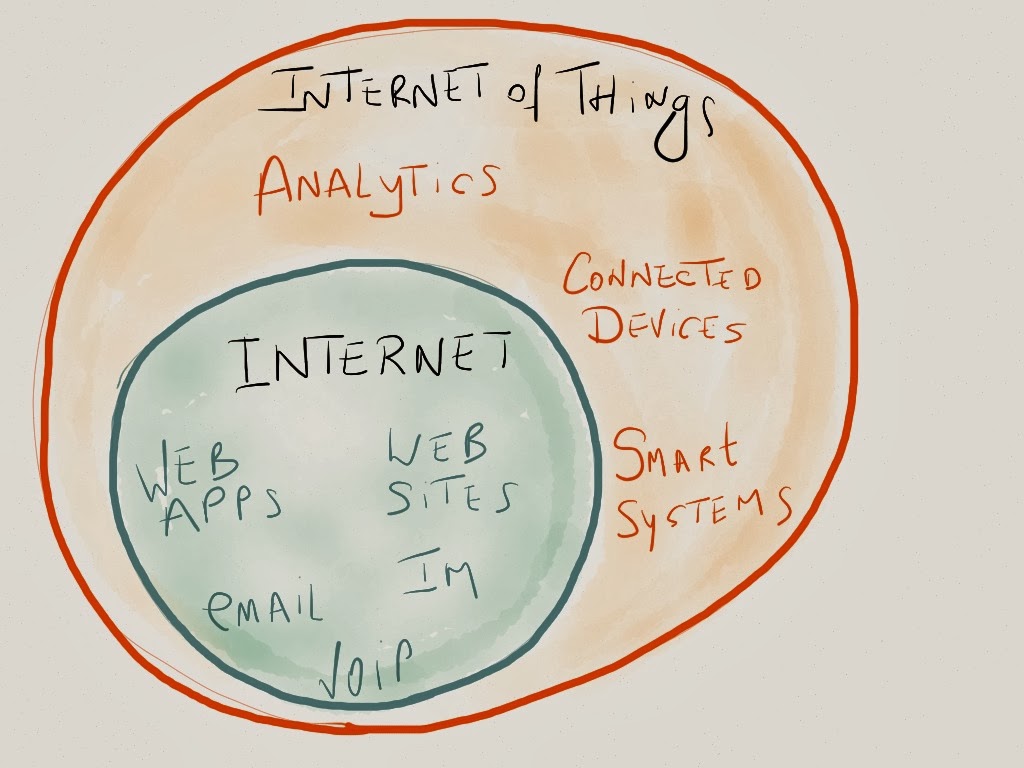

Similarly the Internet of Things starts of by connecting all kinds of devices, mostly via low-power radio. Companies don't really know yet what type of applications these will spawn. A recent announcement by Samsung illustrates the point. The best application of their connected TV is the TV adjusting the thermostat lower when watching a movie about the Artic. You also have the visionary thoughts of cars talking to each other to recommend a great taqueria in the neighborhood. Really?

Terminology and marketing speak aside, the Internet of Things boils down to two key points:

1. IoT is about hooking things up and feeding the Big Data monster

Most of the focus today is about hooking up all kinds of devices. It is a wet dream for the hardware engineers of a decade ago. Hardware projects are sexy again. Take a look at the various Kickstarter projects involving new low-power connected devices. The key challenge is indeed about keeping a small footprint, consuming as little power as possible and being able to communicate in intermittent network environments. And of course this all has to happen in a secure manner.


Although some devices will be communicating with each other, for the majority of devices it is all about feeding the big bad analytics engine in the cloud. Google, Apple, Amazon, GE's Predix, are all salivating about the opportunity to crunch and analyze your habits. Initial applications focus on visualizing the data and creating a historical picture. The various biometrics wristbands are a great example. Wait until the next set of applications will harvest data across devices or databases.

2. IoT is about building Smart(er) Systems

A lesser focus in the technology press is about how connecting more devices, systems and subsystems are creating a new set of intelligent systems. Your cars already have tens and tens of monitoring and CPU devices. A new class of electric and autonomous vehicles show how a new intelligent systems and applications are just around the corner. For many system engineers, this turns the volume up to 11. Indeed, it is challenging how the implement a control loops for these devices. It is more challenging to share data to many more consumers when real-time performance matters.


It is not just about the Jetson's mobile. Smarter systems also include systems such as an interconnected battleground with drones and soldiers with tablets, or a hospital where the infusion pumps, heart rate monitor, etCO2 monitor all talk to each other and provide the nurses station with a simplified view of the health of the patient.

Regardless of whether it is about feeding the big data monster or making smarter systems hum, it is great time to be working on the hardware, protocols or data crunching or integrating systems of the Internet of Things.

I may have this all wrong.  IoT may, as Disney's internship posting points out, actually refer to the Internet of Toys. Big Toys.

Monday, November 11, 2013

Fourth visit to Bass Lake

We visited Bass Lake, near Oakhurst and south of Yosemite over five years ago. Typically we camped out during the hot summer months on the South shore and take a dive into the warm lake to cool down. Bass Lake is an artificial lake and used for boating, jet skiing and swimming.

On our fourth trip to the Sierra national forest, we stayed on the north shore of Bass Lake, close to the dam. As it is November, all the power boaters are gone and with them their large mosquito sounds. Rather than hundreds of water vehicles, I only counted 3 boats the entire weekend. The lake was calm, which is great for fishing for rainbow trout. Most of our weekend was spent on the empty Marina View docks with our fishing poles in the water and reading a book.


Sunday, November 03, 2013

Camping among the redwoods in Boulder Creek

A couple of pictures from this weekend's camp out among the redwoods in the backcountry of the Boulder Creek Scout Reservation


Allowances

It's fun to drive a bunch of scouts to an outing. Besides a sing-a-long of What does the fox say, you get to learn a bit about the boys. Yesterday the topic of allowances came up. This is since recent an important topic for my son as he is responsible to pay a portion of the monthly cellphone plan. He saved and paid half of a new iPhone 5c. I added him to my plan with unlimited voice, text and internet. However he has to pay 50% of the $30 monthly service plan for his phone.

Both kids have been receiving a weekly allowance since last year. Saving is important. At this age, I want to also teach them how to spend. I use the iAllowance iPad application. I love the fact that you can set up an automatic interest for the savings account, so they can appreciate the magic of compound interest. Also it is not all about the money: you can earn stars and free ice cream.

Until recent, both kids were able to earn $3 every week. It was not tied to any chores. Now that obviously my son is coming up short to pay his monthly cellphone plan, he asked to revise the allowance amount. We are changing the allowance upwards, though with strings attached.

Here are those nasty terms and conditions:

  1. You do not earn any allowance if you do not participate in the regular household chores. If you do not do any of the basic chores such as making your bed, cleaning up your room, cleaning of the table, there is no allowance this week. 
  2. No allowance is given if you do not practice your music instruments or sports. 
  3. Your allowance includes a big portion for you to spend and learn how to spend wisely and another portion to save. 
  4. You can earn extra allowance by doing a special chore such as planting vegetables in the planter box or cleaning the car.  
  5. It is your responsibility to make sure your allowance is credited to your iAllowance account. 

Based upon an article in the Huffington post, the amount is raised to about $0.75 per year of age.

Friday, November 01, 2013

Kid's cellphone contract

The song of the summer is over: "Dad, can I have a cellphone? Da-haad". As my son is more independent and on the road without us, it is a good idea he has a means of contacting us easily. We decided to get him a cellphone. Which cellphone is appropriate is an entire different story. We jointly decided for a smart phone, for which he had to fork over 50% of the initial cost and 50% of the monthly service fee. To complete the cycle we all are accustomed to as adults, we made him sign an official service contract. I created it as a mix of freely available contracts for kids. My son was happy to sign this and even more happy when, as a surprise, we were able to give him his first phone afterwards.


Dad and Mom Mobile - Service Contract

We are excited you will be entrusted with your first mobile phone. Fun fun fun … but there are some rules. This contract between _________________ and _______________ establishes the rules and consequences regarding mobile phone usage. The rules includes, but are not limited to, the following:

Full Access - I must agree to give the device immediately to my parents when they ask for it. I will not hide the password and make it available to my parents at request. At any time, I must fully cooperate in showing them the contents of my device, including contacts, pictures, videos, text messages, or anything else stored in it. My parents may access my phone without my knowledge.

Charged - I will turn off my phone at bedtime and place it in a save location. I will make sure my phone is charged.

Take care - I will know at any time where my phone is and keep it in excellent working condition. I will not share my phone with anyone, except dad, mom, and ___________.

Family - I will not disrupt the family harmony. This means I will turn off my phone at the family table, in a restaurant, in church or when asked by my parents.

Being a person - I understand that having a cell phone is a means of communication, and is not a replacement for actual face to face interaction with my friends and family members. Therefore, when I am with others, I will make the people I am with my priority.

School - I will abide by my school’s rules regarding use of the device. I will not disrupt the class by my phone usage. It is expected I keep up your excellent grades.

Malicious usage - I will not text, email or say anything through the device I would not say in person. I will not use my cell phone to take pictures or video of nudity, violence or other unlawful activity. No porn. I will not use my cell phone for malicious purposes, i.e. bullying, spreading rumors/gossip, etc. nor will I send text messages or visit websites that are vulgar, obscene, or sexual in nature. I understand that such messages or websites are both highly inappropriate and potentially illegal.

Be careful and aware - I will alert my parents if I receive suspicious or alarming phone calls or text messages.I will alert my parents if I am being harassed by someone via my cell phone.

Responsiveness - I will always answer calls or text from my parents. If I miss a call or text from them, I will call or text them back immediately. I will not lie about where I have been or how I am using the phone.

Having a cell phone is a privilege, and it may be suspended at any time for disciplinary reasons. If suspension occurs, that does not negate your financial obligation

Financial commitment - We want you to have some ownership in your new device. While we were happy to buy this initial phone for your use, if it is lost or damaged, you will be responsible for replacing it. The ___________ is an expensive device and costs nearly $___. You have to pay $___ for your part of the device. Monthly, you have a $___ fee that covers your call use, unlimited texting and unlimited data. If you make additional purchases (e.g., through iTunes), you will be required to pay ALL related charges.

I agree to all conditions stated above and will adhere to them with a gracious and positive attitude. Any failure to comply will result in loss of phone privileges.

Date: _______________
Signed by: _______________ 

Sunday, October 27, 2013

Tools of the trade

Lifehacker.com has made a living from documenting productivity tools for your daily life. Getting things done websites each pitch their own methodology and tools. Which tools work for you is a personal affair. Here's a list of the tools I use:
  • Email, Calendar and Writing: both at home and at work I use Gmail, Google Calendar, Google Contacts, and Google Docs/Drive. While Apple Mail, iCal and Addressbook synchronize with Google services, I tend to use the browser as the main interface. I am a big fan of the Gmail simple interface and use the tabbed Inbox daily. A common theme for all the tools is the cloud aspect: data is stored in the cloud and synchronizes across operating systems and platforms between my work laptop, my personal laptop, my iPad and Android HTC One phone. 
  • Todo list: I experiment every few months with new todo managers. For about a year I use doit.im. I love the simple and easy interface, and the fact it works with David Allen's GTD system, which I use. 
  • Taking notes: at work I use Microsoft Word in outline mode for taking personal notes. Unfortunately nothing meets my requirements for a great outliner. When I need to share notes with my colleagues, I use Google Docs. Similarly at home, I tend to go to Google Docs. I never got into Evernote, as it lacks some basic outliner features. Since recent I started using Google Keep for simple snippets and pictures of whiteboards. A big advantage is that synchronizes with Google Drive and has the ability to distinguish between my work and personal Google accounts. On my iPad, I use Notability to take notes. I like the ability to mix text, pictures and sketches. Sadly only iOS is supported by Notability.
  • Drafting and Sketching: I like Paper on the iPad, although I often run out of screen real estate, and my fingers are too fat. I tend to stick with rudimentary sketches of ideas or basic X-Y graphs. 
  • News and blog reading: ever since the demise of Google Reader (darn you Google!), I switched to Digg Reader. I am a big fan of RSS readers. I use Flipboard on my iPad. I catch up on interesting presentation using Slideshare
  • Social media: I live in a socially segregated world: I post tidbits on Twitter (it's open to the world), I restrict LinkedIn to work and professional sharing, I answer questions on Quora and Stackoverflow. I like Google+ - no surprise for Google fanboy. Although you would think I barely use Google+ as most of my sharing is with family in a walled off family community. I do find a lot of substantial information sharing on Google+, unlike on Facebook. I log in to Facebook to catch up with the gossip du jour among my friends. I am your stereotypical Instagram user sharing food, drinks and signs. I limit sharing of personal and family pics to my walled off Google+ community. (yes, I am married and have two kids, but you wouldn't know from Facebook or Instagram.) Buffer.App helps me posting to social media. 
  • Instant messaging: Adium (iOS)
  • Video Conferencing: I use Webex at work, as it has the benefit to allow people to dial in from a mobile phone or landline. At home, Google Hangouts is streaming our household across the pond every weekend. 
  • Data Storage: MacOS Time Machine to USB hard drives and a Synology NAS, combined with Google Docs and DropBox. I use DropBox only for a few things: using IFTTT to store all my Instagram pictures in a single folder and for whitepapers, eBooks and other reading material as I can open it on any of my devices. 
  • eBooks: I dropped iBooks for Kindle on iOS and Android. Regardless of the device I can access my book. 
  • Experimental tools: TicTrac as my personal data dashboard; Prezi for online presentations. 
  • Specialized: Microsoft project, and a whole suite of Software development tools. 
When you take a moment to list all the applications you use, you are amazed about how many there are. I wonder how things got done 25 years ago. 

Let me know if you have any interesting tools or if a category is missing.

Sunday, July 21, 2013

July 21, a new king

As Belgium gets a new king, Chris Froome is crowned the new Roi du 100er edition du Tour de France. Kittel est le prince des Champs.

I've enjoyed watching the Tour more than other years, and with reason. A lackluster Cadel Evans and the early departure of Belgium's hope Jurgen Van den Broeck aside, this Tour had a lot of excitement.

A true king
Although Chris Froome started the race as the favorite, it was not handed to him. His rivals didn't waste any time and started attacking from the first day in the Pyrenees. Unlike other years where you waited for some action only to be disappointed time after time: yes, Schleck brothers, I am talking to you. Throughout the tour the attacks kept coming. More over, Froome didn't just defend his yellow jersey. He attacked, won stages and earned it thread for thread. A calm and humble Froome rightfully crowns himself the winner of the 2013 Tour de France.

Picture: The Guardian

The battle among the knights
On the flat stages, it remained exciting. There was the battle royal between the sprinters. Cavendish got unseated by mister-needs-a-new-barber Marcel Kittel. Although Andre Greipel got a seat at the sprinter's banquet as well.

The day they attacked the castle
You would expect the legendary ascend to the Mont Ventoux or the double Alpe D'Huez stage to be the most exciting ones. Nope. The flat stage 13 between Tours and Saint-Amand-Montrond was cycling at its best. First, an unlucky Valverde got behind. Then, Froome and Sky were put on defense when Quickstep, Belkin and Saxo took advantage of the cross winds. It was fighting for every second. Finally, Cavendish finished it off nicely.

New blood
Surprises came from Nairo Quintana, the dynamic Dutch duo Bauke Molema and Laurens Ten Dam, and Jan Bakelants who won a stage and got the yellow jersey for Belgium for a couple of days. 

The jester
It was of course of no surprise that Sagan, winning the green jersey, would bring a little show as he wheelied through the mountains and across the finish lines. 


Relive the Tour with http://www.steephill.tv/tour-de-france/.

Tuesday, July 09, 2013

My new found digital leash

Since a few months I am tracking some of my daily habits using a Fitbit Flex wristband and Aria scale. Interconnected devices. The internet of things. M2M. Oops, I've been brainwashed recently by the IoT marketeers, but got enough antidote to escape its tentacles.

Techcrunch, Lifehacker, GigaOm all have written extensively about devices such as the Fitbit Flex, the Nike Fuelband (as glorified in Casey Neistat's Make it Count video), or the Jawbone Up.

I was initially interested in a device which tracks my sleeping habits. I know I do not get enough rest. Six hours are a blessing. I wondered  how solid the few hours I do sleep are. It is a bonus the device also tracks my steps.

Although I have a "computer-job", I do tend to walk around lot (1). Now that I can track it, I am more encouraged to hit my daily 10,000 steps. I haven't hit it consistently yet. That's my next step.

Not only am I connected most of my awaken hours, I now have my version of a prisoner's ankle bracelet, albeit a cool one. When anyone asks, I'll just mention that my parole officer doesn't allow me to talk about it.

Career development is always and at least once a year

In recent weeks I have been preparing several career development plans (CDP) for my direct reports. This is a multi-step process starting with the employee answering a set of questions, and for engineers a technical skill-set self-assessment. Typically over a lunch we discuss theses answers and review the self assessment. The next step is for me to write up my opinion on the employee: strengths, areas of improvement, and development steps.

Previously when engineers asked when the next CDP will be, my answer was simple: "CDPs are always. Don't wait for a specific HR designated time period. Let's talk in our regular one-on-one about this."

One-on-ones are typically weekly. If there is one thing I want to pass along to new managers is to have regular one-on-one meetings with your team. Talk about the projects, but also about how they see things in the company or their opinion on pending decisions. Over the last 7 years, it is my habit to have one-on-ones while walking around the company neighborhood. This is a habit I picked up from my first manager at RTI: she was pregnant at the time and wanted to include walks in her daily routine. The habit stuck with me. I must have logged hundreds of miles in recent years in the Sunnyvale area. The Northern California weather helps.

I've written up my career advise opinion -'cause that is all that really is: my opinion- for several employees now. I must admit it has been quiet complementary to the one-on-one mentoring and career advise. This is in part thanks to the guiding CDP questions and the fact that we make it a special focus. Thus I've come around: career development is always and at least once a year.

Sunday, July 07, 2013

Douglas Englebart got me a $100

When in March of 2012, Robert Cringely took his family on a day through computing history, he had breakfast at IHOP with Woz, tea with Douglas Englebart, and a grabble in the Google snackbar when visiting Andy Hertzfeld. That was all before visiting the Computer History Museum in Mountain View of course.

When somebody had asked me to plan a similar trip, the same three gentlemen would be part of my trip. (I probably would have tried to squeeze in a few more folks.) All three are in the quiet geek hero category and live in the shadow of Steve Jobs. Even in the valley of geeks are some of them unknown.  I once made a lofty $100 of a bet on who invented the mouse. Steve Jobs $0; Douglas Englebart $100.

Unfortunately my trip through computer history will have one stop fewer as Douglas Englebart passed away last week.